
You know that feeling you get when you are in the AP US History class and it is time to take the test. You sit down. The pencil What’s my score after the last shot?
It is at this point that an APUSH Score Calculator will be a student’s best friend. Eliminates post-exam “spiral” and reduces anxiety with clarity.
What Is an APUSH Score Calculator?
An APUSH Score Calculator is a spreadsheet that is used to estimate a student’s final “grade” (on a scale of 1-5) on the AP US History based on their performance on each part of the exam. It is similar to the College Board’s own composite scoring approach and converts raw scores to a likely final score.
These calculators are popular among students, tutors and test preparation coaches alike. They assist in assisting learners in comprehending their position prior to official outcomes in July.
Why Students Use an APUSH Score Calculator?
It’s stressful to wait for official AP scores. The APUSH Score Calculator allows students to get an early estimate of their score immediately after taking the exam. It also enables the identification of which parts of the composite score made the greatest (or least) contribution to it.
These are extremely useful tools not just after exams, but also for use during practice. The APUSH Score Calculator can be used after every complete-length practice to monitor progress over time and identify areas in which students need to improve prior to test day.
Structure of the AP US History Exam.
It is important to know the format of the APUSH exam before you get into the details of how an APUSH Score Calculator works. AP US History is composed of two sections, each with two parts.
Section I includes:
Part A — consists of 55 questions, each of which is worth one mark, and is to be completed in 55 minutes.
Part B — Short Answer Questions (3 questions, 40 minutes)
Section II includes:
Part C — (1 essay, 60 minutes): Document Based Question
Each of the two marks is worth 40 minutes.
All parts are given specific weights for the final composite score. It is crucial to comprehend this breakdown if you are to use any APUSH Score Calculator accurately.
These are exactly the weights a reliable AP Calculation Score is using to get from raw scores to a composite score, which then is translated into the 1–5 AP scale. Typical range 0 to approximately 150 (depending on the year).
Using an APUSH Score Calculator Step by Step
The APUSH Score calculator is easy to use. Here’s a breakdown of how most of the tools go about it.
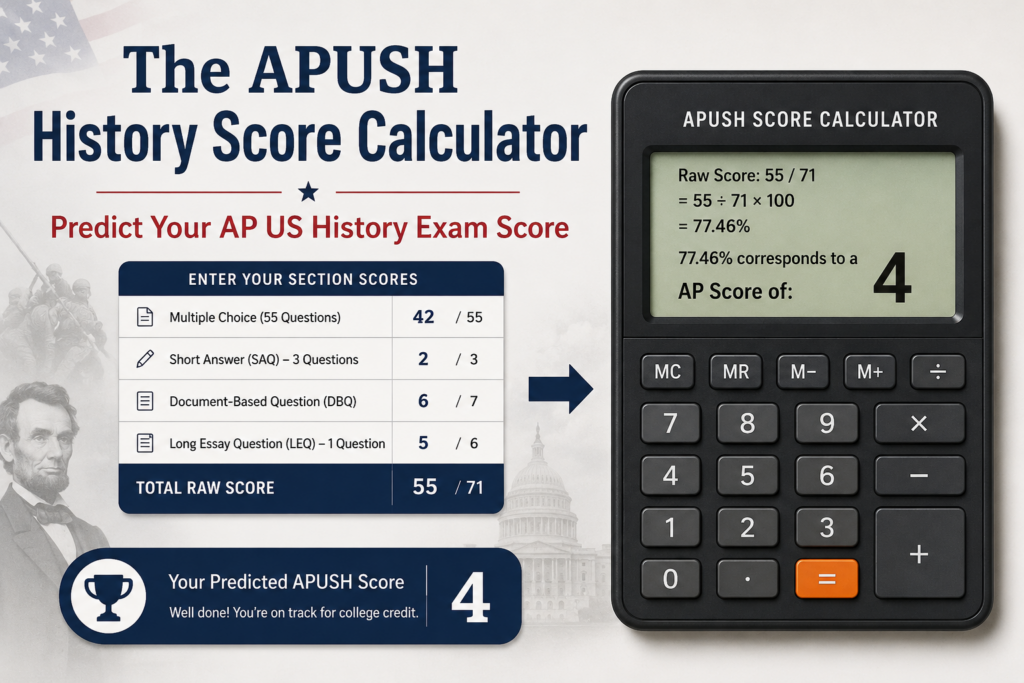
Step 1: Enter the raw score for the MCQ.
Step 2: Enter the SAQ Score
The Short Answer Questions are three questions, each of which carries 3 marks (raw scores, 0–3) if it is answered correctly. The APUSH Score Calculator then multiplies this by its weighted conversion factor to get the SAQ composite contribution.
Step 3: You will enter the DBQ Score.
AP readers use a rubric of 0-7 to grade the Document Based Question. This is the longest weighted free answer section! Students type in their projected or actual DBQ scores, and the calculator then weights them at 25%.
Step 4: The Long Essay Question is scored a range of 0–6.
Students choose one of the three prompts and their score is added in the last box of the APUSH Score Calculator. The weight of 15% is automatically applied.
Step 5: Check out a predicted AP Score
Upon entering all four components, the tool provides a total composite and a prediction of the composite score based on the individual scores as either a 1, 2, 3, 4, or 5. Most calculators also display the composite range of each score level to let students know how close they are to the next level.
It is important to be familiar with the 1–5 AP Score Scale.
Any APUSH Score Calculator will end with a grading of 1-5. Here are the meanings of each score
1— Well Qualified.Good performance credit or advanced placement is most likely at most colleges.
2 — Qualified: meets the lowest performance level for college credit at many institutions.
3 – Possibly Qualified: below the credit level at most colleges.
4 — No Recommendation: Student has not mastered the standard.
For those students who are thinking of earning college credit, a 3 or 4 is the goal.
Competitive universities usually require a 4 or a 5 for credit or placement. With this context, the result of the APUSH Score Calculator is much more significant.
The Calculator for Practice Test Analysis is used for the following purposes:
Perhaps one of the most effective, yet less used, features of an APUSH Score Calculator is when it comes to practice. Students who take their practice test scores on the calculator each week get a moving average of how prepared they are.
For instance, if a student gets 38/55 in the MCQ, 6/9 in the SAQ, 5/7 in the DBQ, and 4/6 in the LEQ, they can start with those numbers. The APUSH Score Calculator would give the student a score in the 4 range, and provide them with some actual feedback — a reality check — a few weeks before the actual exam.
This is a positive feedback loop that enhances the effectiveness of practice, relative to just doing questions without measurement.
Most frequent errors made with an APUSH Score Calculator
Inaccurate results are sometimes obtained due to avoidable input errors from the students. These are the most frequently made errors and pitfalls to avoid.
Mixing up raw data with percentages. The calculator must be used with raw scores (actual number of points scored) not percentages or letter grades. Any percentage entered will cause the entire composite to be off-base.
Skipping the SAQ. It’s a student mistake that some students might forget to incorporate the Short Answer section of the exam, particularly if they had worked on a lot of essays in the prep course. Any missing or zero value in any field will significantly underestimate the final composite.
Waste of time in using self-graded DBQ scores. The DBQ is assessed on a detailed rubric. If a student self-grades without carefully reading the rubric, the student may overrate or under-rate the grade for his/her essay. Seeing the AP rubric guides along with the APUSH Score Calculator yields more accurate results.
Different Score Cutoffs for Different Years
It should be noted that this conversion from composite to scores is not constant. Each year, the College Board uses a method called “equating” to adjust the cutoff scores to reflect the differences in difficulty of the examination administered in that year.
That is, an APUSH Score Calculator based on the historical data is a best estimate, not an absolute guarantee. The cutoffs for a score of 3 may vary slightly from year to year. A good calculator will make note of this and give a range instead of a prediction.
Students should view the results as an informed guess and not official College Board results, and should use it for planning and self-assessment purposes.
These are specific strategies for improving each section score.
In the MCQ: Focus on reading comprehension of primary sources, charts and maps, read and compare the information. AP US History MCQ – Analytical skills are just as much being tested as historical knowledge. Realistic practice times will increase speed and accuracy.
In the SAQ: practice writing brief, supported answers in the 3-part format. Unlike a thesis,
SAQs are not required to be a statement, but they must be precise. The composite can earn important points from three well-constructed responses.
Master the sourcing,
In, contextualizing and complexity criteria in the DBQ. These are the best points and the most commonly missed points. With the proper feedback, a focused week of DBQ practice can move the score from 4 to 6.
Make sure you choose one that most closely matches your knowledge base, not the most current content covered. Apply the skill of writing clear thesis statements and consistent argumentation in a time constrained setting.
Students can see the actual results of their targeted work in the gains to their scores by running updated scores through the APUSH Score Calculator after each improvement cycle.
The best APUSH score calculator is the one you can easily find. You will find the best APUSH score calculator if it’s easy to find.
A number of high-quality test preparation firms have online calculators for the APUSH free of charge. Along with the practice questions, five of the main AP exam prep sites, including Albert.io, Fiveable, and AP Classroom-adjacent sites, might also feature score estimators.
When selecting a calculator, ensure that the calculator is suitable for the current exam format (post 2015 redrawn exam) and that there is a clear indication of the conversion methodology. Older calculators that have incorrect weightings or pre-redesign rubrics will give incorrect weights.
The top tools are clear about their assumptions and remind users that score cutoffs differ for each year.
No, Gives a robust prediction using historic score thresholds and weighted formulas.
Difficulty is a subjective one, but APUSH always has a moderate pass rate. Essay format demands good writing skills, critical thinking skills, and knowledge.
When are official AP scores released?
AP scores are usually published by the College Board about two months after AP exams. Students can use an APUSH Score Calculator in the meantime to help them plan college credit conversations early on.
Will the calculator be allowed in self graded practice tests?
Yes, which is one of its best uses. Students may use the official rubric to grade their own essay for the most accurate accuracy of the calculator’s grade.
Conclusion:
The APUSH Score Calculator is really helpful for students getting ready. It won’t tell you what you’ll get on the exam but it gives you a good idea to help you stay motivated and focused on doing well.
The APUSH Score Calculator helps you understand your AP US History practice test scores.
It won’t tell you what you’ll get on the exam but it gives you a good idea to help you stay motivated and focused on doing well.
The APUSH Score Calculator helps you understand your AP US History practice test scores.
It shows you where you need to improve.
The APUSH Score Calculator is a tool.
Try our APUSH Score Calculator