
In this tutorial:
The basics of the ERA Calculator are covered to help get you started.
The stats of baseball are an important game in themselves and few stats are as significant as the Earned Run Average. An ERA Calculator is a fantastic tool for the fans, coaches and analysts as it allows them to quickly analyse the performance of a pitcher without having to do the calculations.
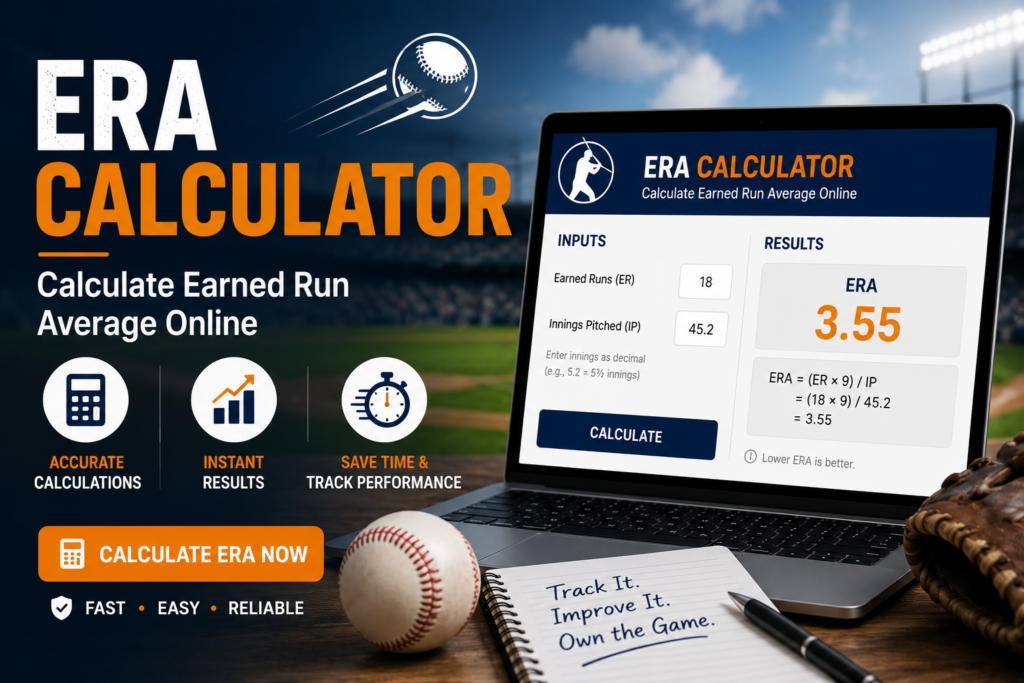
It’s a basic rule of baseball, knowing how to calculate ERA, whether you are watching a youth league or professional baseball. The ERA Calculator makes it easy and provides immediate, accurate results.
One of the most known pitching statistics in baseball.
ERA only takes into account earned runs, which are runs scored as a result of no fielding error or passed ball. This provides a truer picture of how effective a pitcher is.
What is an ERA Calculator?
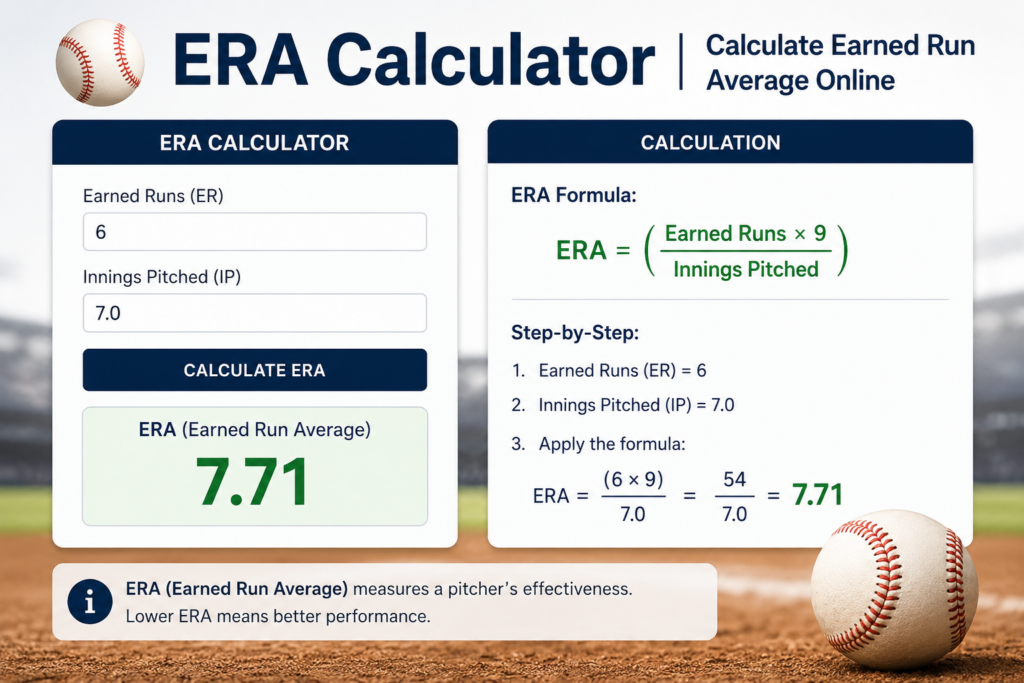
An ERA Calculator is a very simple, yet highly effective, formula that provides results. The user only has to enter 2 numbers: earned runs allowed and innings pitched.
The tool calculates the “standard” ERA automatically and gives a final number in seconds. This will save time and prevent human error in manual calculation.
The ERA Formula (Explanation)
That number provides an accurate, standardized measurement of pitching ability for games of varying lengths.
Why Use an Online ERA Calculator?
There are several benefits to utilizing an online ERA Calculator, as compared to manual calculations. Quick, easy to use and doesn’t require prior statistical knowledge.
An online tool can help compare the pitchers’ performances rapidly when there are many pitchers under the coach’s control. These calculators are also extremely handy for parents monitoring youth league statistics during hectic times.
Personal Analysts & Coaches ERA Calculator.
Professional organizations use ERA as a starting point before going for more complicated statistics. A quick and easy to use instrument to estimate it on the spot makes the decision-making process efficient.
Knowing what a good ERA is in baseball.
The level of play affects a good ERA. An ERA of less than 3.00 in Major League Baseball is considered to be great, and any ERA above 5.00 is worrisome.
For amateur or youth baseball, the standards will be different, but the ERA Calculator is the same regardless of baseball level. The results can be interpreted based on the respective league requirement of coaches and players.
Manual calculation vs ERA Calculator.Manual calculation vs ERA Calculator.
Manual calculations can introduce some inaccuracies in the ERA, particularly if partial innings are being considered. A lot of pitchers get outs without finishing innings making it even more complicated in the calculations.
Fractional innings are automatically dealt with by an ERA Calculator. It will convert partial innings (such as 6.1 innings pitched) to the proper decimal form for accurate results.
In ERA calculations, the rest of an inning is simply ignored.The rest of an inning will be completely ignored in ERA calculations.
Partial innings are one of the most difficult aspects to calculate ERA. An out on the first appearance in an inning is 1/3 of an inning, and a second appearance is 2/3.
This is taken into account automatically with the ERA Calculator that was created for baseball. The user just types in the innings as they would normally (6.1 or 7.2, etc.) and the tool will convert it correctly before using the formula.
ERA in Youth and Amateur Baseball
The use of statistics to track the development of youth and amatuer leagues is becoming more frequent. The ERA Calculator is a simple application that allows these grassroots spaces to benefit from professional-level tracking.
It is important that parents, volunteer coaches, and league administrators have an easy way to keep stats accurate. Promotes a culture of performance tracking from young.
Comparing Pitchers: ERA
The ease with which an ERA Calculator allows side-by-side comparisons is one of the most helpful of its many features. ERAs can be used to compare two pitchers with different ER and innings pitched.
This normalized comparison is especially helpful when evaluating which pitcher to start in an important game. Decision-makers have the number on the table that creates a level playing field.
ERA and its meaning when evaluating a pitcher.
ERA is rarely used alone by serious analysts, but remains a crucial beginning point. It gives instant knowledge on how the pitcher is doing compared to the league average.
This number can easily be automatically produced by the ERA Calculator in a single game or over a season. Looking at ERA over time also can show trends which may not be apparent in raw statistics.
There are some restrictions that ERA is not a perfect statistic.
While ERA is a valuable metric, it does have some limitations. Does not factor in the caliber of the pitcher’s defense or the quality of the parks in which the games are played.
To compensate for some of these shortcomings, advanced statistics such as FIP (Fielding Independent Pitching) have been created. But, the ERA Calculator is still a good place to begin when looking at pitching performance.
Fantasy Baseball’s new ERA Calculator.
Pitching statistics are the bread and butter of fantasy baseballers, and ERA is one of the most popular categories. An ERA Calculator is very useful for any fantasy manager to use when assessing trade offers and waiver wire picks.
If a pitcher is available who has pitched well in a limited number of innings, it takes time to calculate ERA manually. That analysis, however, can be performed instantaneously through an online tool, providing an advantage for fantasy managers.
Try to keep the number of times you click the button to the minimum.You should click the button as few times as possible.
This output gets updated in seconds, and can be read at standard ERA levels in the corresponding league or level of play.
Calculate player stats for a season vs a single game.
Some calculators can be used to record ERA for an entire season, and others can be used to record ERA for a single game. These both have value for use depending on the situation.
A single-game ERA Calculator can be helpful for post-game analysis. A season-long tracker, however, assists coaches and analysts in seeing the trends in a season.
The era of baseball statistics is arguably not that old.The era of baseball statistics is not really over the hill yet.
ERA traces its origins back to the late 19th century, but was officially standardized in the early 20th century. It was designed to give a better indication of a pitcher’s skillfulness than just wins and losses.
The era Calculator will make this ancient statistic available digitally today. Archaic calculation and scorekeeping is now a thing of the past, as it is now instant online.
ERA Calculator on Mobile Devices
Today’s ERA Calculator applications are optimized to work on mobile devices. Any coach with a smartphone can bring it to the dugout and fans in the stands can find instant results.
Mobile-friendly design translates to no zooming or pinching and no small input fields. Everything runs smoothly, quickly and with real-world simplicity.
You can use these free ERA Calculator Tools online to calculate the ERA for any baseball game.
Today there are numerous free ERA Calculator tools on the Internet. They do not need to be registered, they do not need to be downloaded, they do not need any subscription, they just need a browser, and a few numbers.
Free online calculators are a great option for leagues and teams with limited budgets to keep accurate pitching statistics. They provide pro business calculations for free.
Conclusion
The final section provides a conclusion that extolls the virtues of having an ERA calculator on hand for every man who likes the game of baseball.
The ERA calculator is one of the easiest-to-use but most effective tools in baseball analytics. Converts raw game data into a meaningful and actionable statistic in seconds.
This tool is accessible for any kind of pitcher evaluator, whether that be an experienced analyst, a weekend-league coach or a curious fan. The first step to getting a better understanding of the game is understanding ERA — and calculating it is easier than ever.
Try our Playback Speed Calculator